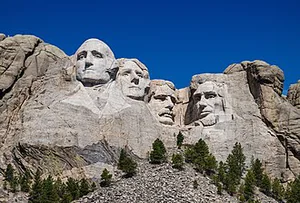
Picture this: you're standing in a pine-fringed clearing in South Dakota's Black Hills, and looming above you are four American presidents, each carved sixty feet high into a sheer granite cliff. George Washington's steady gaze. Thomas Jefferson's thoughtful expression. Theodore Roosevelt's rough intensity. Abraham Lincoln's weary, empathetic eyes. It's a sight that doesn't just impress — it stops you cold.
Mount Rushmore is more than a monument. It's a slab of American storytelling chiseled into living rock, a place that draws nearly three million visitors a year. Each face is the height of a six-story building, and each carved eye is eleven feet wide. Yet despite the colossal scale, the experience feels strangely intimate. The sculptors gave these men real character — you can see the crow's-feet at Lincoln's eyes, the determined set of Jefferson's jaw — and that makes the mountain feel almost alive.
It's also a place of unexpected stillness. The crowds fade as you wander the trails, and all you hear is wind, birdsong, and the echo of your own footsteps. On clear mornings the granite glows pink and gold in the first light. In winter, the faces drift in and out of the mist like ghosts. That's the magic of Mount Rushmore: a collision of nature, art, and sheer national ambition, sitting quietly in the middle of the American prairie.
The story behind the sculpture is nearly as dramatic as the faces themselves. It began in 1923, when South Dakota state historian Doane Robinson floated the idea of carving giant Western heroes — Lewis and Clark, Buffalo Bill — into the Black Hills to lure tourists. He pitched the plan to sculptor Gutzon Borglum, a fiercely ambitious artist with a taste for the monumental. Borglum looked at Mount Rushmore and had bigger ideas. He chose not cowboys, but presidents: Washington, Jefferson, Roosevelt, and Lincoln. Four men he believed represented the birth, growth, development, and preservation of the United States.
Work began on October 4, 1927, and didn't wrap up until October 31, 1941. That's fourteen grueling years of blasting, chipping, and polishing. About 400 workers — miners, quarrymen, and craftsmen — used dynamite and pneumatic jackhammers to remove roughly 450,000 tons of rock. There were no computer models or blueprints; they worked from plaster scale models, measuring instruments, and pure nerve, dangling over the cliffs on simple leather harnesses. Remarkably, not one worker lost their life.
Borglum himself died just a few months before the finish, and his son, Lincoln Borglum, oversaw the final phase. Congress, meanwhile, kept threatening to pull the plug on funding, forcing the team to race against the clock. The original vision included a grand staircase and a chamber behind Lincoln's head meant to hold America's most important documents. That dream never fully came true, but in 1941 the sculpture was declared complete. Today, Mount Rushmore stands as a dizzying symbol of American grit — a country that literally carved its heroes into its own mountainside.
When you arrive, don't just snap a photo and leave. Start with the Avenue of Flags — 56 banners representing the states, districts, and territories — which leads you to the Grand View Terrace and that first, unforgettable view of the mountain. Then duck into the Lincoln Borglum Visitor Center for the short documentary; it's packed with historic footage of the actual blasting. But the real magic lives on the Presidential Trail. This winding loop, less than a mile long, climbs more than 400 steps and brings you right up to the base of the mountain. Up close, you can see the drill marks, the texture of the granite, and the astonishing detail the sculptors achieved from such a distance. It's a bit of a workout, but it transforms the experience from a postcard into a personal encounter.
Plan for at least three to four hours to do the place justice — longer if you're staying for the evening. Here's something that surprises most visitors: there's no entrance fee. You pay only for parking, which is charged per vehicle. And if you want to go deeper, make a beeline for the Sculptor's Studio, tucked away near the base of the mountain. Inside, you'll find Borglum's original scale models and the tools he used, including the beam-like 'pointing machine' that helped him scale the design from inches to acres. It's a humble, dusty little building, but it offers one of the most personal connections to the workers' craft.
For photographers, the Grand View Terrace is the classic shot, but the real hidden gems are elsewhere. At the far end of the Presidential Trail, you'll find an angle where the presidents seem to loom directly overhead — perfect for dramatic low-angle photos. You can also drive out to scenic overlooks along nearby mountain roads to catch the silhouettes of the faces from behind, a perspective almost nobody bothers to chase. And from late spring through summer, the nightly lighting ceremony is pure magic: a ranger-led program that ends when the floodlights snap on and the mountain glows against the darkening sky. It's honestly a little spine-tingling.
One last secret: look closely at the raw, unfinished granite just to the right of Washington's face. That's where Borglum's grander dreams never got realized. Behind Lincoln's head, you can just make out the dark opening of the 'Hall of Records' — a seventy-foot chamber blasted into the rock to hold the nation's founding documents. It was never completed, but the opening remains, a quiet monument to ambition that even this massive artwork couldn't fully contain. Wander, sit, stare, and let the sheer wonder of the place sink in. Mount Rushmore may be one of the most photographed landmarks on Earth, but nothing prepares you for standing beneath it in person.