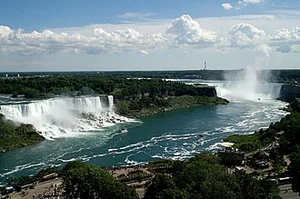
You feel it before you see it. A low, distant rumble that seems to vibrate through your boots, then a faint coolness in the air. You turn a corner, and there it is—Niagara Falls, a curtain of living water that has been thundering for thousands of years. On the American side, you're not just a spectator above the falls; you're part of the spectacle. The sheer volume of water—millions of gallons every second—crashes over the edge with a roar that makes you instinctively lower your voice. It's awe, but with an undercurrent of wildness that no photograph can capture.
The mist rises like a pale ghost, swirling around the green islands that dot the brink. Sunlight often slices through, painting a ribbon of rainbow across the spray. You'll see it from Prospect Park, from the decks of the Maid of the Mist, from the wet boards of the Cave of the Winds. In winter, the mist freezes into sculptural ice castles, and in summer it feels like a tropical rainstorm. Niagara isn't just a landmark; it's one of those rare places that demands you feel it—with your ears, your skin, your very bones. It's impossible to be indifferent.
The story of Niagara begins about 12,000 years ago, when retreating glaciers sculpted the Great Lakes and sent the Niagara River tumbling over a limestone escarpment. The falls have been eroding upstream ever since, and the nicest canyons you see today are the trenches left behind by that slow, relentless march. The first European to describe the scene was Father Louis Hennepin in 1678, and his account read so fantastically that many readers doubted him. But the falls were already sacred to the Indigenous Onondaga, Seneca, and Tuscarora people, who knew the thunder for what it was: a living presence.
As the centuries passed, Niagara became a stage for human audacity. In 1901, schoolteacher Annie Taylor became the first person to survive going over the Falls in a barrel. More than a dozen daredevils followed, some with absurd costumes, some with tragic endings. Meanwhile, engineers were approaching the Falls with different ambitions. In the 1890s, Nikola Tesla's alternating-current system powered the first hydroelectric plant here, proving that Niagara's raw force could light up entire cities. The same energy that thrilled honeymooners was now the engine of modern industry. And it was conservationist Frederick Law Olmsted who saved the riverbanks from becoming a mess of souvenir stalls, creating Niagara Falls State Park in 1885—the oldest state park in the U.S. That park is your gateway today.
Start your visit at Niagara Falls State Park, which is open year-round and completely free to enter. The main path leads you past the thrilling overlooks: Prospect Point, with the American Falls churning directly below, and Luna Island, a tiny nub of green that splits the American Falls from the smaller Bridal Veil Falls. Stand there, and you'll feel the spray on your face within seconds. The striking thing about the American side is how close you get to the water. You're not just looking down at a waterfall; you're right at its shoulder, watching it tear a line through the rumpled stone.
To really get inside the falls, you have to get wet. The Maid of the Mist has been leaving from the US dock since 1846, a stubby boat that ferries you directly into the swirling basin of the Horseshoe Falls. Every passenger gets a blue plastic poncho, and honestly, you'll need every millisecond of its protection. The boat rocks, the mist turns into torrents, and you feel like you're inside a storm cloud. On the other hand, the Cave of the Winds takes things to a different level. You'll wear sandals, a poncho, and a brave smile as you ride an elevator down to the base of Bridal Veil Falls. Then you'll climb a series of wooden walkways—the Hurricane Deck—where a wind of 30 miles per hour hurls spray right at you from only 20 feet away. It's not for the faint of heart, but it's why you came.
Give yourself a full half-day, if not a full day. The classic route is this: watch from above, cruise below, then get soaked at Cave of the Winds. But don't rush. Walk out to Goat Island, the quiet heart of the park, and find the Three Sisters Islands. They're a hidden gem where locals come to picnic, and the view of the rapids from their wooden bridges is a million miles from the tourist bustle. Also check out the Niagara Gorge Discovery Center, where you can trace the falls' receding edge through painted murals and hands-on exhibits. As for photo spots, skip the crowded rail at Prospect Point first thing in the morning; instead, aim for Terrapin Point on Goat Island for a face-on view of Horseshoe Falls (the falls actually extends half a mile at sunset with a golden glow). And the iconic shot of the rainbow over the American Falls? You'll get it from the deck of the Maid of the Mist, or from the edge of the Cave of Wind's Hurricane Deck—just be ready to wipe the lens of your phone.
For those who want a deeper secret, consider the Bridal Veil Falls' smaller platform on Luna Island. Most visitors walk past it without a glance, but it's the only place on the US side where you can feel the raw updraft from the churning pool below. And if you're after a little history without mussing your hair, the Visitor Center's terrace offers a view of the original stone guardhouse and the statue of Nikola Tesla that honors his genius. Remember, the Niagara Falls you see today is a constantly moving masterpiece. By the time you leave, it will have carved away another layer of the riverbed, and you will have been part of that story—if only for a moment. Bring your waterproof jacket, keep your camera close, and give this place your full attention. It will seriously take your breath away.