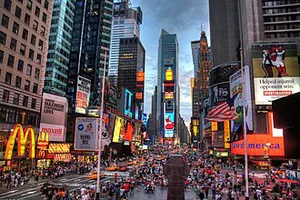
You feel it before you see it – a low electric hum that builds into a symphony of jumbles, shouts, and show tunes. Then you round a corner, and the world seems to split open in a riot of color. Welcome to Times Square, the self-proclaimed 'Crossroads of the World.' It's a place where giant digital billboards cascade down glass towers like waterfalls of pure light, where every step feels like a scene from a movie, and where you're never quite sure if you're the star or just an extra. For first-timers, the sheer sensory overload is staggering; the blinking signs, the costumed characters, the swarming crowds. But that chaos is precisely the point. This isn't a neighborhood to be experienced quietly. It's a living, breathing, screaming expression of New York City's relentless energy.
For over a century, Times Square has been a global icon, a symbol of American ambition and urban spectacle. It's where New Year's Eve kisses happen, where Broadway dreams are sold, and where the city's pulse is easiest to feel. Tourists from every corner of the planet gather here, their faces lit by the glow of a hundred Jumbotrons, all searching for that same perfect photo. The place has a strange magic – it's tacky and awe-inspiring all at once. You'll likely roll your eyes at a novelty store one second, then look up at the towering neon canyons and feel genuinely small. That contradiction is what makes it unforgettable.
Though its history is bathed in neon, Times Square began as something far humbler. Back in the mid-19th century, the area was known as Long Acre Square, a quiet residential district punctuated by horse stables and carriage trades. It wasn't until 1904 that its fate changed forever. The New York Times decided to move its headquarters to a new skyscraper at 42nd Street and Broadway, and the city renamed the intersection in the newspaper's honor. The very first New Year's Eve celebration was held that year, complete with fireworks and a temporary sign that descended at midnight – a tradition that persists today, though the modern ball is now a glowing orb of Waterford crystal.
For the next few decades, Times Square grew into the theatrical heart of the city, glittering with marquees, vaudeville houses, and luxurious hotels. The electrified billboards arrived in the 1920s, turning the district into a true beacon of modern spectacle. But the mid-century brought a darker era. As Broadway theaters moved further uptown and the middle class fled to the suburbs, the square decayed into a seedy district of peep shows, dive bars, and crime. For a while, 'Times Square' meant grit, not glamour. It wasn't until the 1990s that city officials and corporate giants, led by Disney, launched a massive revitalization effort. The old porn palaces were demolished, family-friendly shops moved in, and the pedestrian plazas you see today – with their bright red stairs and café tables – were installed in 2009. That's the strange thing about Times Square: its history is a story of constant reinvention.
Now, let's talk about what to actually do here. First, understand this: Times Square itself has no entrance fee, no ticket booth, and no line to wait in. It's a public space, and the 'attraction' is pure sensory overload. Your best bet is to simply wander. Stroll the wide pedestrian plazas between 42nd and 47th Streets, weaving through the slow-moving tide of visitors. Look up – really up – at the billboards. The biggest one, at the intersection of Broadway and 7th Avenue, is a curved, crystalline screen that changes with every glance. If you're lucky enough to be here in the evening, the light show begins. The neon signs pop against the darkening sky, and the whole square feels like a giant, open-air theater.
As for your time budget, I'd say a solid one to two hours is plenty to soak in the vibe without feeling swallowed whole. If you're catching a Broadway show, plan to arrive earlier and use the time to absorb the pre-theater energy. There's no 'ticket' for Times Square, but the nearby TKTS booth offers discount same-day tickets for Broadway shows – just be prepared for a queue. And speaking of queues, the best photo spot in the square is the red bleacher stairs on the north side between 45th and 46th Streets. Climb those steps, turn around, and you'll have the classic shot: the neon canyon stretching out behind you, the yellow cabs snaking through the traffic, and the crowd below, looking like a river of human life. Drop down to street level for a less cliché angle – look for the small, nondescript plaque in the center of the square that marks the middle of the 'Great White Way.'
Here's a hidden gem many miss: the interior of the Ticketmaster booth on the west side is surprisingly calm, and its glass walls give you a quieter view of the madness. Also, slip into the old Times Square subway station's entrance at the north end of the plaza. The underground corridors have a vintage tiled aesthetic and a fascinating, if accidental, art installation of lit stairwells that echo the neon above. If you're feeling brave, strike up a conversation with the iconic Naked Cowboy – he's a grizzled street performer who's been a fixture since the 1990s. And while you're walking, keep an eye out for the subtle 'Walk of Fame' stars embedded in the pavers, honoring performers from the Broadway stage. Few visitors ever think to look down.
One last piece of advice: don't rush off the moment the initial shock wears off. Find a spot on the red steps, sit back, and just watch the world spin. You'll see a proposal happening near the MTV studio, a group of German tourists comparing battle selfies, a masked superhero breaking into an impromptu dance. That's the real Times Square. It's chaotic, commercial, and utterly original. You'll probably hate the crowds and love the spectacle in equal measure. But I guarantee this – you won't soon forget the way it feels to stand in the middle of that electric storm. That's the magic of the Crossroads of the World. It's not just a place; it's a moment that you carry with you long after you've stepped away from the neon.